
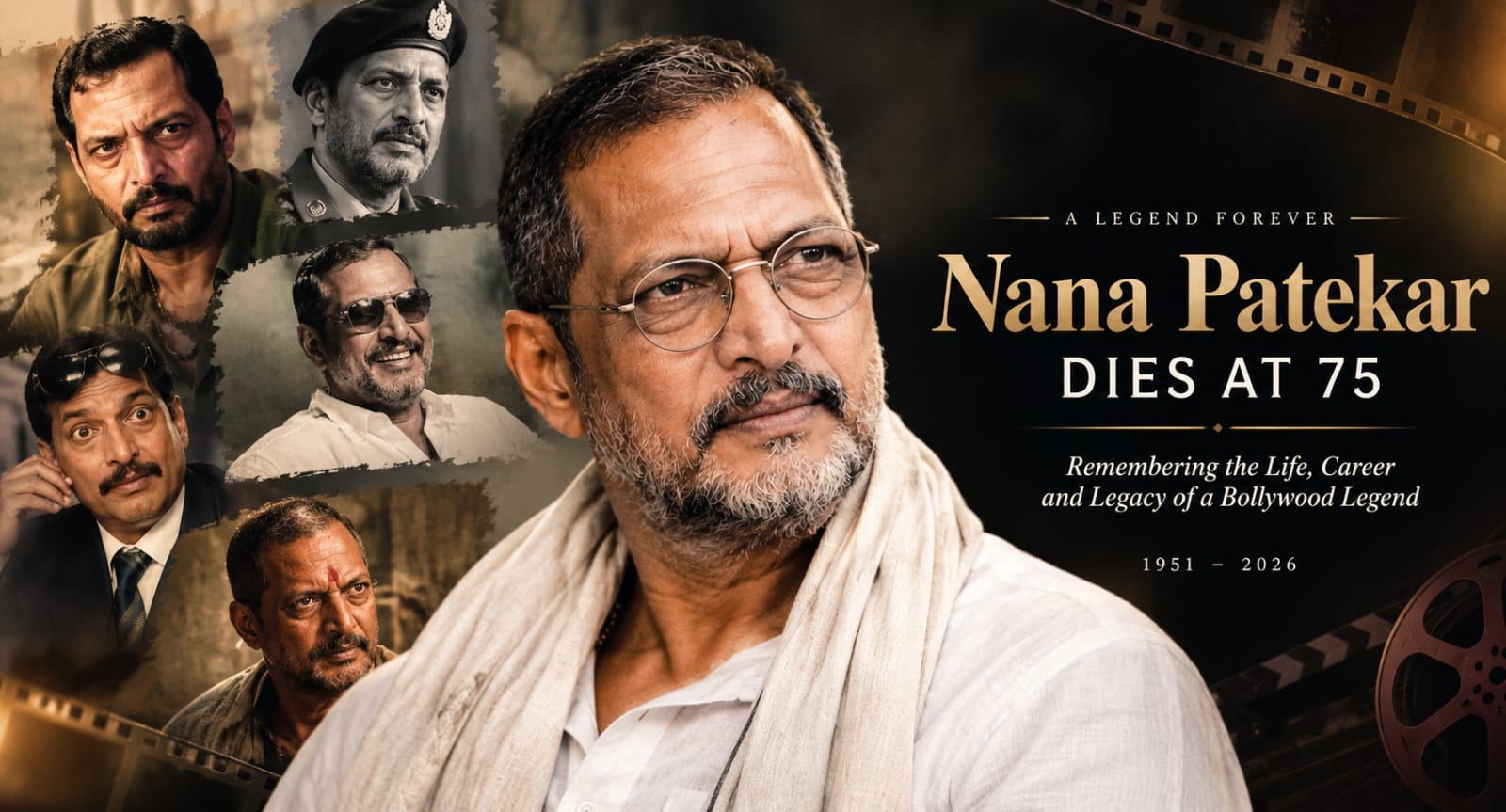
Veteran actor Nana Patekar, one of Indian cinema’s most powerful, distinctive and respected performers, has died at the age of 75. The actor passed away on Thursday, October 8, 2026, after suffering a cardiac arrest at his residence in Dona Paula, Goa. He was later taken to Manipal Hospital, where doctors attempted to revive him for around 45 minutes, but he could not be saved.
His death brings an end to a remarkable career spanning more than four decades across Hindi and Marathi cinema, theatre and filmmaking. Patekar leaves behind a body of work defined by unforgettable characters, extraordinary intensity and a style of dialogue delivery that became almost impossible to imitate.
For generations of audiences, Nana Patekar was more than a film star. He was an actor whose presence could transform an ordinary scene into a memorable cinematic moment.
Nana Patekar’s Early Life
Born Vishwanath Patekar on January 1, 1951, in Maharashtra, Nana Patekar grew up far removed from the glamour and privilege often associated with the film industry.
He later studied at the Sir J.J. Institute of Applied Art in Mumbai and gradually found his way towards theatre and acting. His early years were marked by struggle, discipline and persistence, experiences that would later become an important part of the raw and realistic quality he brought to his performances.
Before becoming one of Indian cinema’s most recognisable faces, Patekar spent years developing his craft through theatre and smaller film roles.
That difficult beginning helped shape the performer audiences eventually came to know — intense, fearless, realistic and emotionally powerful.
Entry Into Cinema
Nana Patekar made his Hindi film debut with Gaman in 1978. His early work included both Hindi and Marathi cinema, where he steadily built a reputation as a serious performer.
His appearance in Mira Nair’s Salaam Bombay! in 1988 brought him wider national and international recognition. A year later, Parinda became a major turning point in his career.
His powerful performance in Parinda earned him the National Film Award for Best Supporting Actor and firmly established him as one of the most formidable performers of his generation.
The Rise of a National Award-Winning Actor
The 1990s became one of the defining periods of Nana Patekar’s career.
He delivered memorable performances in films such as Raju Ban Gaya Gentleman, Angaar, Tirangaa, Krantiveer, Agni Sakshi and Khamoshi: The Musical.
His performance in Krantiveer (1994) became one of the most celebrated performances of his career. The role earned him the National Film Award for Best Actor along with a Filmfare Award.
He later won another National Film Award for Best Supporting Actor for Agni Sakshi (1996). With three National Film Awards to his name, Patekar established himself among the most acclaimed actors in Indian cinema.
From Serious Drama to Comedy
One of Nana Patekar’s greatest strengths was his extraordinary versatility.
He could convincingly portray a police officer, gangster, politician, troubled individual or emotionally broken man, bringing a distinct intensity to every character.
But he was equally capable of making audiences laugh.
His portrayal of Uday Shetty in Welcome (2007) introduced a completely different side of the actor to a new generation. His expressions, timing and unmistakable dialogue delivery turned Uday Shetty into one of Hindi cinema’s most memorable comic characters.
He later returned to the role in Welcome Back (2015).
His other notable films included Shakti: The Power, Ab Tak Chhappan, Apaharan, Raajneeti and several Hindi and Marathi productions.
Natsamrat and His Marathi Cinema Legacy
Despite becoming a major name in Bollywood, Nana Patekar remained deeply connected to Marathi cinema and theatre.
In Natsamrat (2016), he played the role of Ganpat Belwalkar, a retired stage actor whose life takes a deeply emotional and tragic turn. His performance was widely praised and once again demonstrated his ability to carry an emotionally demanding film almost entirely through his performance.
The film became an important milestone in his Marathi career and further strengthened his reputation as an actor capable of expressing pain, loneliness and vulnerability with remarkable authenticity.
Nana Patekar as a Director
Patekar was not limited to acting.
He also stepped behind the camera and made his directorial debut with Prahaar: The Final Attack, a film centred on the discipline, struggles and lives of soldiers.
His association with the armed forces extended beyond cinema. He underwent military training while preparing for Prahaar and later became associated with the Territorial Army, receiving the honorary rank of Lieutenant Colonel.
His connection with the armed forces became one of the lesser-known but significant chapters of his life.
His Contribution Beyond Cinema
Nana Patekar’s contribution was not limited to films.
He was also involved in social work and, along with actor Makarand Anaspure, was associated with the Naam Foundation, which worked to support farmers and drought-affected communities in Maharashtra.
Away from the glamour of Mumbai’s film industry, Patekar was known for his relatively simple lifestyle and his strong connection with rural Maharashtra.
His public image was often very different from that of a conventional Bollywood celebrity — understated, direct and grounded.
Awards and Honours
During his extraordinary career, Nana Patekar received some of the most prestigious honours in Indian cinema.
His major achievements include:
- Three National Film Awards
- Multiple Filmfare Awards
- Filmfare Marathi Award
- Maharashtra State Film Awards
- Padma Shri in 2013
The Padma Shri recognised his contribution to Indian cinema and the arts, adding another major honour to a career already filled with critical acclaim.
A Voice and Style That Could Never Be Replaced
Nana Patekar was never an actor who needed elaborate costumes or larger-than-life presentation to command attention.
His greatest weapons were his voice, expressions, pauses, body language and extraordinary command over dialogue.
A simple sentence delivered in his unmistakable voice could carry anger, humour, pain or authority. His ability to control the rhythm of a scene became one of the defining characteristics of his acting style.
From the intensity of Parinda and Krantiveer to the humour of Welcome and the emotional depth of Natsamrat, Patekar repeatedly showed that his range extended far beyond a single genre.
Nana Patekar’s Final Chapter
Nana Patekar spent his final years remaining connected with cinema and public life. He was still active and had continued appearing in films and public events.
On October 8, 2026, he suffered a cardiac arrest at his residence in Goa. He was found unconscious and taken to Manipal Hospital, where doctors tried to revive him for around 45 minutes. He was declared dead at approximately 5:20 a.m.
The news of his death sent shockwaves across the Indian film industry, with colleagues, fans and public figures paying tribute to the veteran performer.
Maharashtra also announced that he would be accorded a state funeral in recognition of his contribution to theatre and cinema.
A Legacy That Will Live On
Nana Patekar’s journey was never simply about becoming a Bollywood star.
It was the story of an artist who came from a modest background, discovered his calling through theatre, endured struggle and eventually became one of the most respected performers in Indian cinema.
For more than four decades, he created characters that audiences did not merely watch — they remembered.
His performances could make viewers laugh, feel anger, experience heartbreak or simply fall silent. His voice became iconic, his characters became unforgettable and his acting style became uniquely his own.
Nana Patekar may have left the world, but the characters he created will continue to live on through Indian cinema.
From Parinda and Krantiveer to Agni Sakshi, Welcome and Natsamrat, his work will remain a part of the country’s cinematic memory.
Rest in peace, Nana Patekar.
Indian cinema has lost one of its most distinctive artists — but the legacy of an actor who made silence, anger, humour and emotion speak louder than words will remain alive for generations to come.