
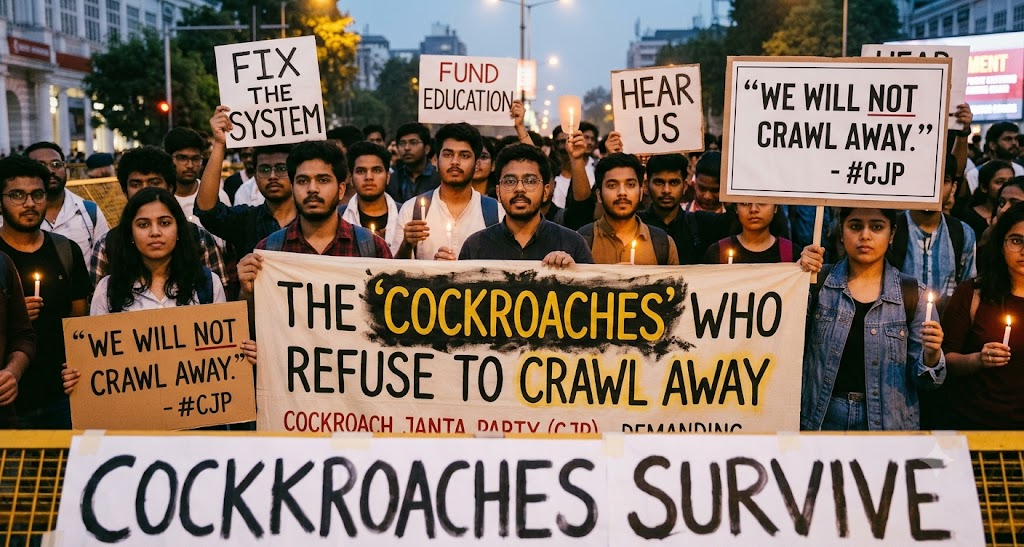
Over the last week, Cockroach Janta Party-led protests demanding the resignation of the Union Education Minister and sweeping reforms to the education system have spread across the country. Students and their allies say they will continue despite allegations of state excesses.
By Nikhil M. Babu, Shrimansi Kaushik, Serena Josephine M., and Vinaya Deshpande
From university gates in Delhi to crowded street corners in Chennai, from campuses in Kolkata to district headquarters in Maharashtra, a slogan has travelled with unusual speed: “We will not crawl away.”
View this post on Instagram
It is the cry of the Cockroach Janta Party (CJP), an unlikely student-led coalition that has spent the past week turning anger over the education system into a nationwide movement. Their demands are direct: the resignation of the Union Education Minister, an independent inquiry into alleged irregularities, and reforms that make public education more accessible, accountable and humane.
The name, organisers say, is deliberate. “Cockroaches are what people call those they want to dismiss, erase or step on,” said a student organiser at a protest in Delhi, declining to be named. “We chose it because we are done being treated as disposable. We are still here.”
The movement began as a campus demonstration, sparked by frustration over rising costs, delayed scholarships, examination uncertainty and allegations of heavy-handed action against students. Within days, images of sit-ins, marches and hand-painted placards began circulating online. Local groups adopted the CJP’s symbols and language, while adding their own demands: better hostels, transparent recruitment, disability access, functioning grievance systems and more funding for government institutions.
In several cities, protests have continued despite restrictions on assembly and claims by demonstrators that police used excessive force to disperse crowds. Authorities have maintained that action was taken to preserve public order. Protesters, however, say the response has only widened support for their cause.
At a gathering in Bengaluru, students sat in silence for nearly an hour, holding books above their heads. In Kolkata, demonstrators staged a mock classroom on the pavement. In Lucknow, parents and former students joined a candlelight march, saying the crisis could no longer be framed as a problem limited to campuses.
“This is not only about one minister or one incident,” said a postgraduate student in Hyderabad. “It is about a generation being asked to compete, pay more and accept less—less certainty, less support and less dignity.”
The CJP’s decentralised structure has made it difficult to contain. There is no single spokesperson, no permanent stage and no uniform programme beyond a shared set of demands. WhatsApp groups and student networks have helped coordinate protests, legal support and medical assistance. That flexibility has also allowed the movement to reach beyond elite universities, drawing in students from colleges, coaching centres and vocational institutes.
Critics have questioned whether the movement can sustain itself without a formal leadership structure. Organisers insist that is precisely the point.
“We have seen movements disappear when a few people are targeted,” said an organiser in Mumbai. “This one belongs to everyone who has ever felt that education is being taken away from them.”
For now, the protests show little sign of fading. As evening fell at one demonstration, students taped sheets of paper to a barricade. Each carried a short message: Fix the system. Fund education. Hear us.
Below them, in thick black paint, someone had written the line that has come to define the week:
“Cockroaches survive.”