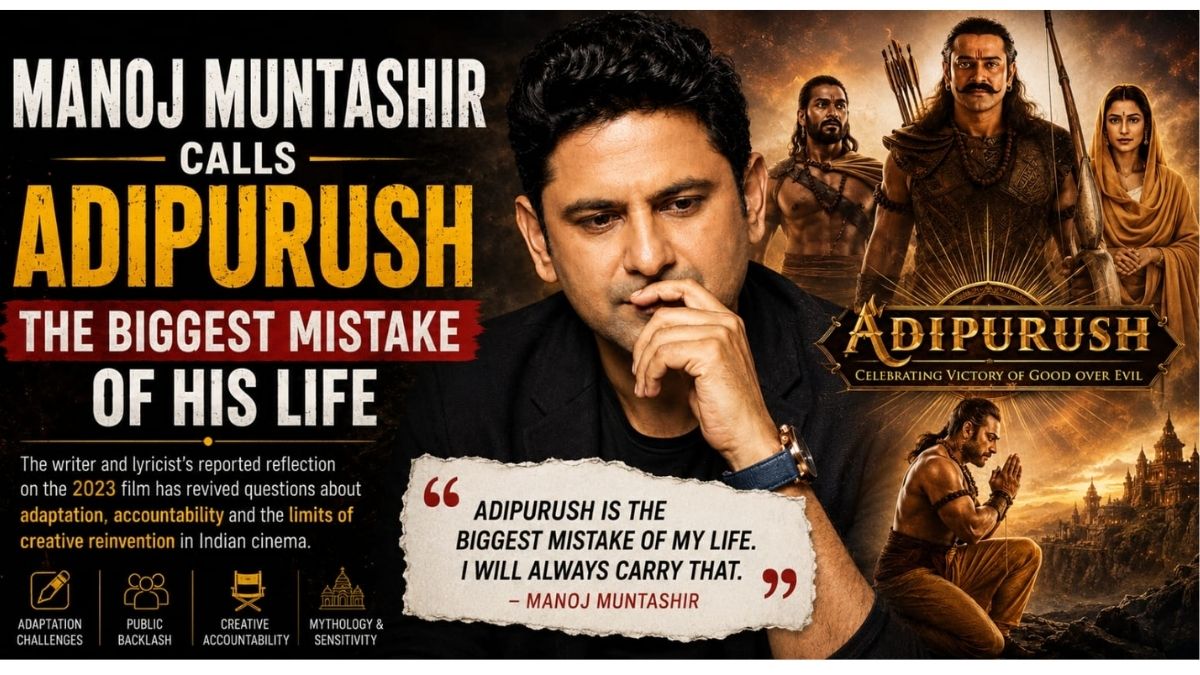
Mumbai: Manoj Muntashir has reportedly described Adipurush as the “biggest mistake” of his life, reopening a debate that has continued long after the film left theatres.
For Muntashir, who wrote the dialogues for the ambitious retelling of the Ramayana, the film’s journey from a high-profile release to a national controversy remains one of the most closely watched episodes in recent Hindi cinema. Adipurush arrived in June 2023 with a major cast, a huge budget and the weight of one of India’s most familiar epics behind it. But the response was swift, intense and deeply polarised.
Directed by Om Raut, the film starred Prabhas as Raghava, Kriti Sanon as Janaki and Saif Ali Khan as Lankesh. It was pitched as a modern, large-scale cinematic interpretation of the Ramayana, designed to bring an ancient story to a younger, global audience. Instead, it drew criticism from viewers, scholars, religious groups and film commentators, many of whom objected to its visual choices, dialogue and characterisation.
The backlash centred especially on the language used by certain characters. Critics said some lines felt too casual and contemporary for a story rooted in religious tradition. Others took issue with the visual representation of characters and settings associated with the epic. As the criticism mounted, the film’s makers revised some dialogues after release, but that did little to contain public anger.
Muntashir had earlier defended the creative choices made in the film, saying that the team had attempted to make the story accessible to contemporary audiences. The argument was familiar: that mythology must evolve to remain relevant. But Adipurush demonstrated how difficult that balance can be when the source material is not merely literary, but devotional and deeply woven into the cultural imagination.
The reported admission is significant because it shifts the conversation from defence to reflection. In an industry where controversies are often met with silence, blame-shifting or elaborate publicity management, an acknowledgement of error carries its own weight. Whether audiences accept it as a genuine reckoning or regard it as a delayed response, it suggests that the makers were unable to anticipate the scale and nature of the reaction.
The controversy also raised a larger question: who owns mythology?
For filmmakers, epics such as the Ramayana offer immense narrative possibilities. Their characters, conflicts and moral dilemmas are known across generations, but can be interpreted in multiple ways. India has a long history of retelling these stories through theatre, television, folk traditions, literature and film. Each version has brought its own imagination to the material.
Yet not every retelling is received in the same way. The Ramayana is not only a story for millions of people; it is also an object of faith. That makes artistic experimentation more complicated. A decision that may appear innovative in a conventional fantasy film can feel insensitive when applied to a sacred narrative. The challenge is not simply to avoid offence, but to understand the emotional and cultural meaning that audiences bring with them.
Adipurush became a case study in that challenge
The film’s scale was one of its central selling points. It sought to compete with global fantasy spectacles, using visual effects, action sequences and a stylised world-building approach. But many viewers felt that the spectacle overwhelmed the spirit of the source material. For them, the issue was not whether the film looked modern, but whether its modernity came at the expense of dignity and emotional depth.
The debate around the dialogues was even more pointed. Dialogue in mythological storytelling carries a special responsibility. It shapes how audiences encounter characters they have known since childhood, often through family traditions, religious readings and television serials. When the language feels out of step with that memory, viewers may experience it as a break in trust rather than simply a creative choice.
The film’s eventual reception showed that a large budget and star power cannot guarantee acceptance. In fact, the scale of the project may have intensified expectations. A story as familiar as the Ramayana invites scrutiny at every level—from costume and design to tone, language and moral perspective. Audiences do not approach it as a blank canvas.
For Muntashir, the lesson may be as much about listening as writing. A screenplay or dialogue is never judged in isolation. It becomes part of a larger relationship between a film and its audience. In the case of Adipurush, that relationship fractured early and publicly.
There is also a broader industry lesson. Indian cinema has increasingly turned to mythology, history and culturally significant stories in search of big-screen spectacle. These projects can attract attention before a single frame is released, but they also come with heightened responsibility. Filmmakers must navigate a complex space where artistic freedom, commercial ambition and public sentiment meet.
That does not mean mythological stories should be frozen in time. New interpretations are possible, and perhaps necessary. But they demand research, sensitivity and a clear understanding of what is being changed—and why. Reinvention without emotional grounding can quickly appear superficial. Accessibility without respect can seem dismissive.
The Adipurush episode is unlikely to be forgotten soon. It has become more than a discussion about one film’s performance or critical reception. It has become a warning about the risks of adapting beloved cultural narratives without fully appreciating the audience’s connection to them.
If Muntashir’s reported remark is indeed an admission of regret, it may mark a moment of rare candour in the aftermath of a major cinematic failure. It cannot undo the controversy, but it adds a human dimension to it: the recognition that ambition, however sincere, can go wrong.
For audiences, the memory of Adipurush remains shaped by disappointment. For the industry, it remains a lesson in humility. And for Manoj Muntashir, it may stand as the project that changed how he thinks about the responsibility of storytelling.