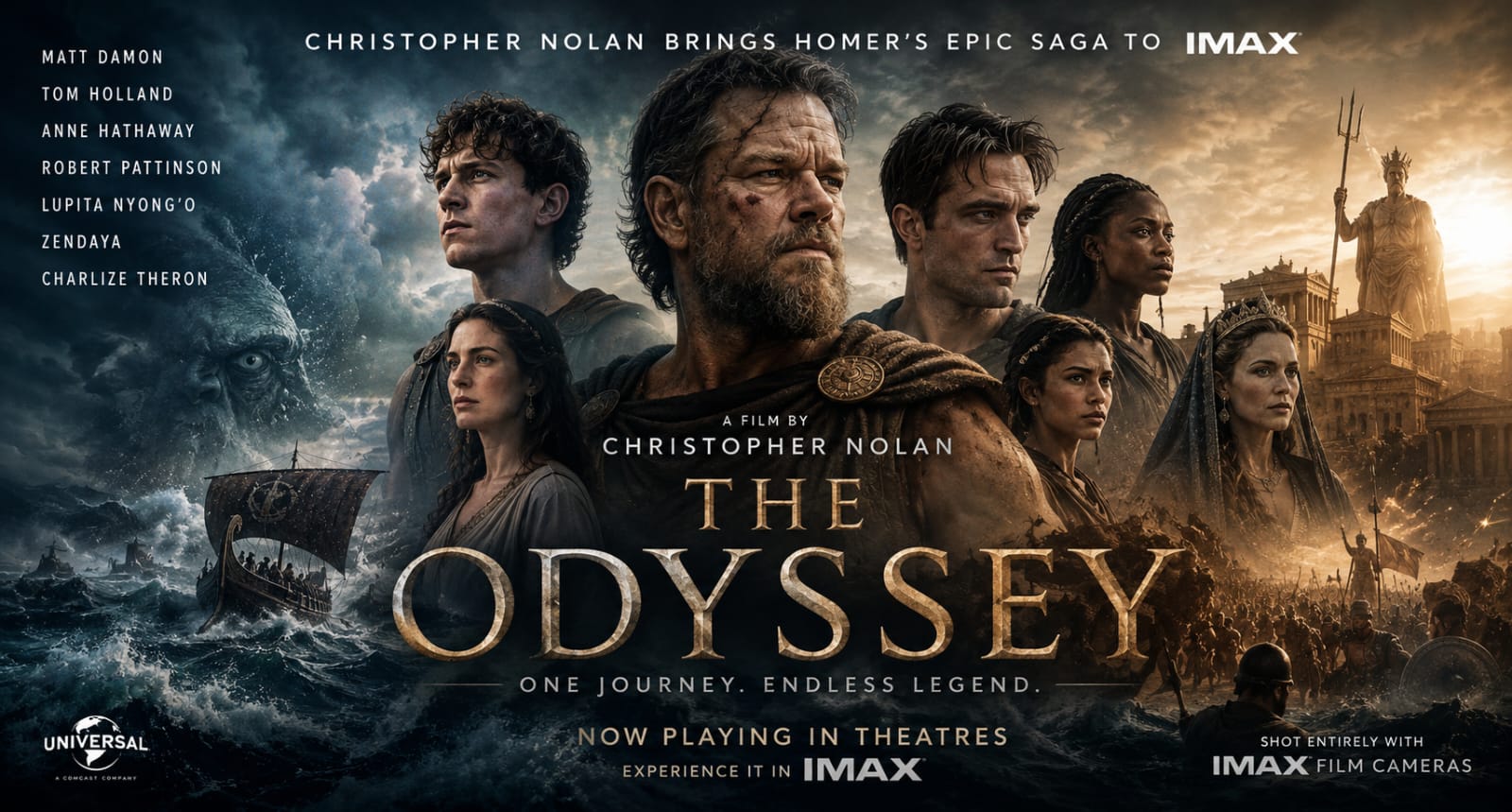
Christopher Nolan brings Homer’s timeless journey to the big screen with a global cast, sweeping locations, and groundbreaking IMAX filmmaking.
Christopher Nolan has built a career on turning ambitious ideas into cinematic events. With The Odyssey, the filmmaker takes on one of storytelling’s oldest and most influential adventures: Homer’s epic account of Odysseus and his long, perilous journey home after the Trojan War.
Released by Universal Pictures, The Odyssey is described as a “mythic action epic” and marks the first time Homer’s foundational saga has been brought to IMAX screens on this scale. Nolan wrote and directed the film, reimagining the ancient Greek poem through the large-format, practical-minded visual style that has defined films such as Interstellar, Dunkirk, and Oppenheimer.
At the centre of the story is Odysseus, the legendary king of Ithaca. After the fall of Troy, his return to his wife Penelope and son Telemachus becomes an extraordinary voyage across a world of storms, monsters, gods, temptation and war. The story’s enduring power lies in its human stakes: beneath its mythic scale, The Odyssey is about perseverance, home and the cost of survival.
Matt Damon leads the cast, joined by Tom Holland, Anne Hathaway, Robert Pattinson, Lupita Nyong’o, Zendaya and Charlize Theron. The ensemble brings together several generations of major screen talent, giving Nolan a strong foundation for a story filled with heroes, rulers, warriors and figures of legend.
The production is just as ambitious as its source material. Shot across locations around the world, The Odyssey was filmed entirely using new IMAX camera technology. That choice is central to Nolan’s approach: the immense landscapes, sea voyages and battle sequences are designed not simply to be seen, but to be experienced on the biggest possible screen.
For Nolan, the project is a natural next step. His films often explore characters facing forces larger than themselves—time, war, history, science or fate. Homer’s Odysseus is one of literature’s original survivors: brilliant, flawed and determined to return to the life he left behind. That makes The Odyssey fertile ground for a filmmaker drawn to spectacle with emotional weight.
The film also arrives at a moment when audiences are looking for theatrical experiences that feel genuinely different. Rather than treating the ancient text as distant history, Nolan’s adaptation positions it as a living adventure—one whose ideas of courage, loyalty, identity and belonging still resonate thousands of years later.
With The Odyssey, Christopher Nolan is not merely adapting a classic. He is taking one of the world’s defining stories and giving it the scale, intensity and immersive power of modern cinema.
The Odyssey is now playing in theatres, including IMAX.